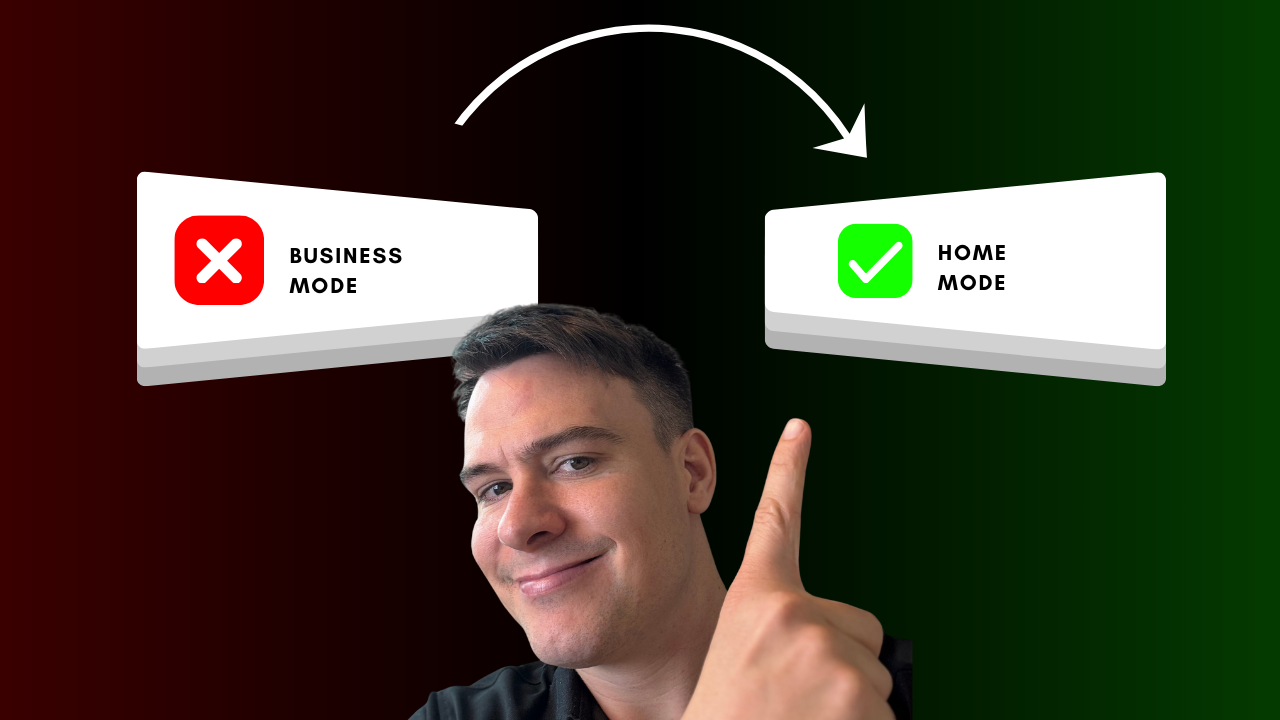
One of the most common struggles I see with entrepreneurs, founders, and high performers isn’t strategy, discipline, or even time management.
It’s switching off.
Not because they don’t care about their family.
Not because they’re selfish or distracted.
But because their nervous system and identity are still in business mode.
And that bleed-over has consequences.
Marriages become strained.
Kids feel the emotional absence.
Home becomes another place of pressure instead of restoration.
And over time, mental health quietly erodes.
This isn’t a character flaw.
It’s a mental fitness issue.
Why Business Mode Is Hard to Turn Off
When you run a business, your mind is trained to:
- Solve problems
- Anticipate risk
- Hold responsibility
- Carry expectations (often unspoken)
That creates open loops, unfinished thoughts, decisions, and emotional weight that your brain keeps active to “protect” you.
From a neurological perspective, your system is doing its job:
- High alert
- Forward-thinking
- Outcome-focused
The problem is, that same operating system doesn’t belong at home.
You can’t simply tell your brain to “relax” when it’s been conditioned all day to stay sharp. Switching modes requires intention, structure, and repetition, not willpower.
This Is a Mindset Shift, Not a Discipline Problem
Most people try to fix this by forcing behaviour:
- “I should be more present”
- “I need to put my phone away”
- “I just need better boundaries”
But behaviour doesn’t change until identity and focus change.
If your identity is:
“I am the business. I am responsible for everything.”
Then your nervous system will stay switched on, even at the dinner table.
The goal isn’t to shut off responsibility.
The goal is to direct your attention consciously.
You Need a Life Vision, Not Just a Business Vision
This is where most entrepreneurs get it wrong.
They have:
- Business goals
- Revenue targets
- Growth plans
But no clear life vision that integrates:
- Marriage / relationship
- Parenting
- Health
- Faith
- Energy
- Presence
Without a life vision, your mind defaults to what it knows best: the business.
A life vision gives your brain a new reference point:
“This is what matters now.”
When your vision includes who you are at home, not just what you build at work, it becomes easier to shift focus, because there’s something meaningful to shift towards.
How to Switch Modes: A Mental Fitness Framework
This isn’t about perfection.
It’s about creating micro-resets that train your system over time.
1. Create Transition Rituals
You don’t need an hour-long routine.
You need a clear signal that one mode has ended and another has begun.
Examples:
- A 3-minute breathing reset in the car
- Changing clothes immediately when you get home
- A short walk around the block
- Writing down tomorrow’s top priorities to close open loops
Rituals tell your nervous system:
“You are safe to stand down.”
2. Use Physical, Mental, and Environmental Cues
Your brain responds faster to cues than to logic.
- Physical: posture change, breath, cold water on the face
- Mental: a single anchoring question
- “Who do I choose to be for my family tonight?”
- Environmental: no laptop in certain rooms, phone out of sight during meals
You’re not removing work.
You’re redirecting attention.
3. Reinforce Your Life Vision Daily
If you don’t rehearse your life vision, your brain won’t remember it under pressure.
A simple practice:
- Read your life vision before leaving work
- Or repeat one line that matters:
“Success means being present, not just productive.”
This keeps your identity aligned, not fragmented.
4. Be Patient — You Will Fall Off
Some days you’ll nail it.
Some days you’ll walk through the door still carrying stress.
That’s normal.
Mental fitness is built through awareness and recovery, not perfection.
Every time you notice you’ve slipped and choose to re-engage — even for 5 minutes — you’re training a new pattern.
The Real Question
Here’s the uncomfortable truth:
What’s the point of building a thriving business if you can’t enjoy the people you’re building it for?
Presence is a skill.
Calm is a trainable state.
And balance isn’t found, it’s practiced.
Next Step
Watch the training below and create your own micro transition rituals.
They don’t need to be impressive.
They just need to be intentional.
Because the goal isn’t to be perfect,
it’s to be present, aligned, and fully available for the life you’re working so hard to build.